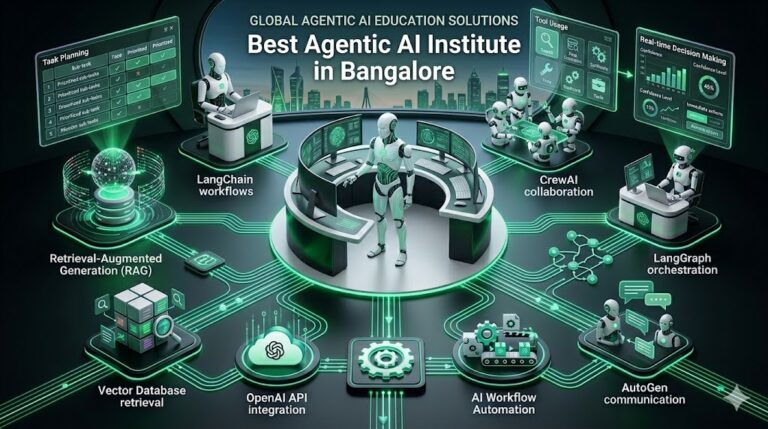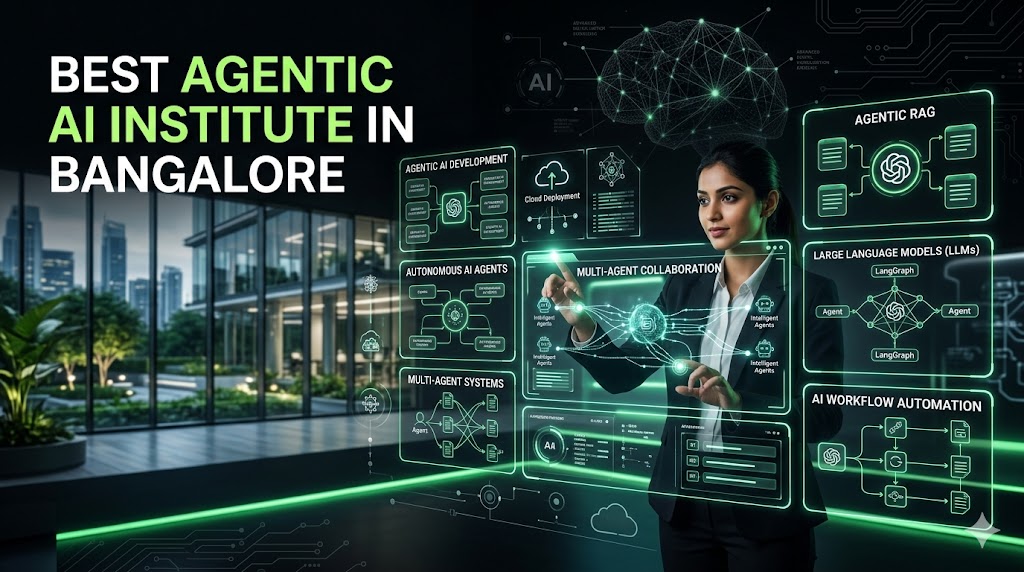
Are you searching for Best Agentic AI Institute in Bangalore | Agentic AI Course & Certification??
Discover the best Agentic AI institute in Bangalore. Learn Autonomous AI Agents, Multi-Agent Systems, Agentic RAG, LangGraph, MCP, LLMOps, AI Agent Deployment, and real-world AI applications with industry-focused training.
Introduction
Artificial Intelligence is evolving at an extraordinary pace. While traditional AI systems were designed to perform specific tasks, the latest innovation in the field is the rise of Agentic AI Development. Unlike conventional AI tools that simply respond to prompts, modern AI agents can reason, plan, make decisions, collaborate with other agents, and execute complex workflows with minimal human intervention.
As businesses across industries embrace Autonomous AI Agents, the demand for professionals skilled in designing, deploying, and managing intelligent agents is skyrocketing. From startups and software companies to healthcare, finance, e-commerce, and manufacturing, organizations are investing heavily in AI Workflow Automation and next-generation AI technologies.
This growing demand has made Bangalore the ideal destination for aspiring AI professionals. Known as India’s Silicon Valley, Bangalore is home to leading technology companies, AI startups, research labs, and educational institutions offering specialized training in Agentic AI.
If you are searching for the best Agentic AI institute in Bangalore, it is important to choose a program that goes beyond theory and provides practical exposure to modern AI ecosystems, real-world projects, and industry-relevant tools. This guide explores what makes an institute stand out and the essential skills you should look for when choosing an Agentic AI course.
Understanding the Rise of Agentic AI
The AI industry is moving from simple chatbots toward intelligent systems capable of independent reasoning and action. Modern Large Language Models (LLMs) have created the foundation for a new generation of AI systems that can perform complex tasks autonomously.
These systems rely on advanced architectures such as:
- Autonomous AI Agents
- Multi-Agent Systems
- Planning Agents
- Tool-Using AI Agents
- Autonomous Decision-Making Systems
Unlike traditional machine learning applications, Agentic AI systems can break down goals into smaller tasks, gather information, evaluate outcomes, and continuously improve their performance.
For example, an AI-powered customer support system can automatically retrieve information from company databases, generate personalized responses, schedule follow-ups, and escalate complex issues when needed. Such capabilities are made possible through advanced AI Agent Orchestration techniques and intelligent workflow design.
As enterprises seek automation at scale, professionals with expertise in Agentic AI are becoming some of the most sought-after talent in the technology sector.
Key Technologies You Should Learn in an Agentic AI Program
The best Agentic AI institute in Bangalore should offer a curriculum that covers both foundational AI concepts and emerging agent technologies.
Large Language Models and Generative AI
Every modern Agentic AI system begins with powerful Large Language Models (LLMs). These models provide reasoning, language understanding, content generation, and decision-support capabilities.
Students should gain hands-on experience with:
- Prompt engineering
- Model fine-tuning
- Context management
- LLM integration
- Generative AI Applications
Organizations increasingly use Generative AI to automate customer interactions, generate content, improve productivity, and enhance decision-making processes.
Retrieval-Augmented Generation and Agentic RAG
One major challenge with AI models is ensuring accuracy and access to current information. This is where Retrieval-Augmented Generation (RAG) becomes valuable.
RAG systems combine language models with external knowledge sources, allowing AI systems to retrieve relevant information before generating responses.
Advanced programs should also cover:
- Agentic RAG (Retrieval-Augmented Generation)
- Knowledge retrieval systems
- Vector databases
- Context-aware reasoning
- Enterprise search solutions
Modern enterprises are increasingly implementing Multi-Agent RAG Systems to improve scalability, collaboration, and information accuracy.
Agent Frameworks and Workflow Design
Building production-ready agents requires familiarity with modern frameworks and orchestration platforms.
Students should learn:
- AI Agent Frameworks
- LangGraph
- Workflow architecture
- Agent memory systems
- Agent communication protocols
Frameworks such as LangGraph allow developers to build complex AI applications where multiple agents collaborate, reason, and execute tasks dynamically.
Essential Skills That Differentiate Top Agentic AI Institutes
Many institutions teach AI fundamentals, but only a few prepare students for real-world implementation.
AI Agent Orchestration
One of the most important skills is AI Agent Orchestration, which involves coordinating multiple AI agents to work together efficiently.
A well-designed orchestration system enables:
- Task distribution
- Resource optimization
- Workflow management
- Collaborative problem-solving
In enterprise environments, orchestration is critical for managing large-scale agent ecosystems.
Model Context Protocol (MCP)
Modern AI applications require seamless integration between models, tools, and data sources.
The Model Context Protocol (MCP) has emerged as a key standard for enabling secure and structured communication between AI systems and external resources.
Students trained in MCP gain valuable experience in building interoperable AI solutions that can scale across organizations.
Prompt Engineering for Agents
While traditional prompting remains important, Agentic AI requires advanced techniques.
Prompt Engineering for Agents focuses on:
- Goal decomposition
- Reasoning enhancement
- Multi-step execution
- Tool selection
- Error handling
These skills help create intelligent systems capable of delivering reliable outcomes in real-world environments.
AI Agent Design Patterns
Professional AI development relies heavily on proven architectures and reusable frameworks.
Learning AI Agent Design Patterns enables developers to create scalable and maintainable systems while reducing development complexity.
Popular design patterns include:
- Planner-executor models
- Reflection loops
- Multi-agent collaboration frameworks
- Memory-enhanced architectures
These patterns form the backbone of enterprise-grade Agentic AI systems.
Real-World Applications of Agentic AI
One hallmark of a leading Agentic AI institute is its focus on practical implementation.
Students should gain exposure to Real-World Agentic AI Use Cases across industries.
Customer Support Automation
Modern support systems leverage Tool-Using AI Agents to retrieve information, answer questions, and resolve customer issues autonomously.
Healthcare Assistance
Healthcare organizations use AI agents for appointment scheduling, patient engagement, documentation support, and information retrieval.
Financial Services
Banks and financial institutions employ Autonomous Decision-Making Systems for fraud detection, risk assessment, compliance monitoring, and personalized financial recommendations.
Supply Chain Optimization
AI agents coordinate logistics, inventory management, forecasting, and vendor communications through intelligent workflow automation.
Enterprise Productivity
Businesses deploy agents for:
- Report generation
- Meeting summaries
- Data analysis
- Research automation
- Internal knowledge management
These examples highlight the growing importance of Autonomous Task Execution in modern organizations.
Deployment, Monitoring, and Security in Agentic AI
Building an AI agent is only the beginning. Real-world deployment requires robust infrastructure and operational excellence.
AI Agent Deployment
Students should understand the complete lifecycle of AI Agent Deployment, including:
- Cloud infrastructure
- API integration
- Containerization
- Scalability considerations
- Production environments
Organizations seek professionals who can move AI solutions from prototypes to fully operational systems.
LLMOps and Operational Excellence
Just as DevOps transformed software engineering, LLMOps (Large Language Model Operations) is revolutionizing AI deployment.
Key LLMOps topics include:
- Model versioning
- Performance optimization
- Monitoring pipelines
- Cost management
- Continuous improvement
Institutes that teach LLMOps provide students with a significant competitive advantage.
AI Agent Monitoring and Tracing
Maintaining reliable AI systems requires visibility into agent behavior.
Students should learn:
- AI Agent Monitoring
- AI Agent Tracing
- Performance analytics
- Failure diagnosis
- Workflow optimization
These capabilities ensure transparency and accountability in AI-powered environments.
AI Agent Evaluation
Before deploying any production system, rigorous testing is essential.
AI Agent Evaluation (Evals) helps assess:
- Accuracy
- Reliability
- Consistency
- Safety
- Goal completion rates
Employers increasingly prioritize professionals who understand evaluation methodologies.
AI Agent Security
As AI systems gain autonomy, security becomes even more important.
Comprehensive programs should include:
- AI Agent Security
- Data privacy
- Access control
- Secure tool integration
- Threat detection
Organizations cannot afford vulnerabilities in autonomous systems, making security expertise highly valuable.
The Importance of Multi-Agent Collaboration
The future of AI lies in collaborative intelligence.
Rather than relying on a single model, enterprises are adopting Multi-Agent Systems where specialized agents work together to solve complex challenges.
Examples include:
- Research agents
- Planning agents
- Analysis agents
- Execution agents
- Validation agents
Through effective AI Agent Collaboration, organizations achieve higher accuracy, better scalability, and improved efficiency.
Advanced systems combine Planning Agents, reasoning engines, and execution frameworks to create highly capable autonomous environments.
Many leading AI companies now use Reinforcement Learning for Agents to improve performance over time, allowing agents to learn from experience and optimize decision-making strategies.
Hands-On Learning Through Capstone Projects
One of the strongest indicators of a quality Agentic AI institute is the emphasis on project-based learning.
Students should complete meaningful Capstone AI Projects that demonstrate practical expertise.
Examples include:
- Autonomous customer support agents
- Multi-agent research assistants
- AI-powered workflow automation systems
- Enterprise RAG platforms
- Intelligent recommendation engines
Capstone projects help learners build portfolios that showcase their skills to potential employers and clients.
Additionally, exposure to ML API Deployment enables students to publish AI solutions as scalable services, a critical requirement for modern AI careers.
How to Choose the Best Agentic AI Institute in Bangalore
When evaluating institutes, consider the following factors:
- Industry-aligned curriculum covering Agentic AI technologies.
- Hands-on training with modern AI frameworks.
- Coverage of RAG, Agentic RAG, and Multi-Agent Systems.
- Training on LangGraph and MCP standards.
- Real-world deployment and LLMOps practices.
- Capstone project opportunities.
- Experienced mentors from the AI industry.
- Placement assistance and career support.
- Exposure to enterprise AI use cases.
- Focus on security, monitoring, evaluation, and production readiness.
An institute that combines theoretical knowledge with practical implementation will provide the strongest foundation for a successful AI career.
Agentic AI is rapidly transforming how businesses operate, automate workflows, and make decisions. Technologies such as Agentic AI Development, Autonomous AI Agents, Multi-Agent Systems, Agentic RAG (Retrieval-Augmented Generation), AI Agent Orchestration, LangGraph, Model Context Protocol (MCP), and LLMOps (Large Language Model Operations) are shaping the future of artificial intelligence.
For aspiring AI professionals, choosing the best Agentic AI institute in Bangalore can be a career-defining decision. The ideal program should provide hands-on experience with modern AI agent frameworks, deployment strategies, monitoring systems, security practices, and real-world business applications.
As organizations increasingly adopt intelligent automation and autonomous systems, professionals skilled in AI agents will be at the forefront of innovation. Investing in a comprehensive Agentic AI education today can open doors to exciting opportunities in one of the fastest-growing technology domains in the world.
The future belongs to those who can build, manage, and optimize intelligent agents—and there has never been a better time to start that journey.
Why Choose IIAIPE for Agentic AI Training?
Choosing the right institute is essential when building expertise in Agentic AI, Generative AI, and intelligent automation. IIAIPE stands out by combining industry-focused learning, practical implementation, and future-ready AI technologies that align with current market demands.
1. Industry-Relevant Agentic AI Curriculum
IIAIPE offers a curriculum designed around emerging technologies such as Agentic AI Development, Autonomous AI Agents, Multi-Agent Systems, Agentic RAG (Retrieval-Augmented Generation), and Large Language Models (LLMs). Students gain exposure to the tools and frameworks used by modern AI teams.
2. Hands-On Project-Based Learning
Learning AI is most effective when concepts are applied to real-world scenarios. IIAIPE emphasizes practical implementation through assignments, case studies, and Capstone AI Projects that help learners build a strong portfolio.
3. Exposure to Modern AI Frameworks
Students learn to work with industry-relevant technologies such as LangGraph, AI Agent Frameworks, Model Context Protocol (MCP), and AI Agent Orchestration tools that are increasingly being adopted by organizations worldwide.
4. Focus on Real-World AI Applications
The program goes beyond theory by demonstrating Real-World Agentic AI Use Cases across industries such as healthcare, finance, e-commerce, customer support, and enterprise automation.
5. Practical Training in RAG and Multi-Agent Systems
IIAIPE covers advanced topics including Retrieval-Augmented Generation (RAG), Multi-Agent RAG Systems, knowledge retrieval architectures, and intelligent workflow design to help students build enterprise-ready AI solutions.
6. Career-Oriented Skill Development
Students develop in-demand skills such as:
- Prompt Engineering for Agents
- AI Workflow Automation
- Autonomous Task Execution
- AI Agent Collaboration
- AI Agent Design Patterns
- Planning Agents
These capabilities are increasingly sought after by employers implementing AI-driven transformation initiatives.
7. Deployment and Production Readiness
Unlike many introductory AI programs, IIAIPE introduces learners to production concepts including:
- AI Agent Deployment
- ML API Deployment
- LLMOps (Large Language Model Operations)
- AI Agent Monitoring
- AI Agent Tracing
- AI Agent Evaluation (Evals)
This practical knowledge helps bridge the gap between learning and real-world implementation.
8. Emphasis on Responsible and Secure AI
As AI systems become more autonomous, security becomes critical. IIAIPE includes exposure to AI Agent Security, governance considerations, and best practices for building reliable AI systems.
9. Expert Mentorship and Industry Insights
Students benefit from guidance that connects theoretical concepts with industry expectations, helping them understand how modern organizations are adopting Agentic AI technologies.
10. Future-Ready Career Opportunities
With demand growing for professionals skilled in AI agents, automation, and intelligent systems, IIAIPE helps learners prepare for roles such as:
- Agentic AI Developer
- AI Engineer
- LLM Engineer
- AI Automation Specialist
- Machine Learning Engineer
- AI Solutions Architect
- AI Product Specialist
FAQs About the Best Agentic AI Institute in Bangalore
1. What is Agentic AI?
Agentic AI refers to intelligent AI systems that can autonomously plan, reason, make decisions, and execute tasks with minimal human intervention.
2. Why should I learn Agentic AI in Bangalore?
Bangalore is India’s leading technology hub, offering access to AI companies, startups, networking opportunities, and industry-relevant training programs.
3. What are Autonomous AI Agents?
Autonomous AI Agents are AI systems capable of independently performing tasks, making decisions, and interacting with tools or other agents to achieve specific goals.
4. What is the difference between Generative AI and Agentic AI?
Generative AI focuses on creating content, while Agentic AI extends these capabilities by enabling AI systems to plan, reason, and take actions autonomously.
5. What are Multi-Agent Systems?
Multi-Agent Systems consist of multiple AI agents working together to solve complex tasks through collaboration and communication.
6. What is Agentic RAG?
Agentic RAG (Retrieval-Augmented Generation) combines retrieval systems with AI agents to access relevant information and make better decisions before generating responses.
7. What is Retrieval-Augmented Generation (RAG)?
RAG enhances AI models by connecting them with external knowledge sources, improving accuracy and reducing hallucinations.
8. Why is LangGraph important in Agentic AI?
LangGraph helps developers build sophisticated AI workflows where multiple agents can interact, reason, and execute tasks efficiently.
9. What is Model Context Protocol (MCP)?
Model Context Protocol (MCP) is a framework that enables secure communication between AI models, tools, databases, and external systems.
10. What skills are required to learn Agentic AI?
Basic programming knowledge, logical thinking, Python fundamentals, machine learning concepts, and an interest in AI technologies are helpful.
11. Is coding mandatory for Agentic AI courses?
Most advanced Agentic AI courses require some coding knowledge, particularly in Python, although beginner-friendly programs may provide foundational training.
12. What is AI Agent Orchestration?
AI Agent Orchestration involves coordinating multiple AI agents and workflows to achieve complex business objectives efficiently.
13. What are AI Agent Frameworks?
AI Agent Frameworks are software platforms and libraries used to build, manage, and deploy AI agents.
14. What are Tool-Using AI Agents?
Tool-Using AI Agents can access APIs, databases, search engines, calculators, and external software tools to perform tasks.
15. What are Planning Agents?
Planning Agents break large goals into smaller tasks and determine the best sequence of actions to accomplish objectives.
16. What is AI Workflow Automation?
AI Workflow Automation uses AI agents to automate repetitive processes, business operations, and decision-making tasks.
17. What is LLMOps?
LLMOps (Large Language Model Operations) focuses on deploying, monitoring, maintaining, and optimizing AI models in production environments.
18. What is AI Agent Deployment?
AI Agent Deployment involves launching AI systems into real-world environments where they can perform tasks for users and businesses.
19. What is AI Agent Monitoring?
AI Agent Monitoring tracks agent performance, usage, reliability, and operational health after deployment.
20. What is AI Agent Tracing?
AI Agent Tracing helps developers understand agent decision-making processes and troubleshoot workflow issues.
21. What is AI Agent Evaluation (Evals)?
AI Agent Evaluation measures the effectiveness, reliability, safety, and accuracy of AI agents using standardized testing methods.
22. Why is AI Agent Security important?
AI Agent Security protects AI systems from unauthorized access, data breaches, prompt injection attacks, and operational risks.
23. What are Autonomous Decision-Making Systems?
These systems use AI to analyze information, evaluate options, and make decisions without continuous human supervision.
24. What are Multi-Agent RAG Systems?
Multi-Agent RAG Systems use multiple specialized agents working together with retrieval systems to improve knowledge processing and response quality.
25. What is Prompt Engineering for Agents?
Prompt Engineering for Agents focuses on designing instructions that help AI agents reason, plan, and execute tasks effectively.
26. What are AI Agent Design Patterns?
AI Agent Design Patterns are proven architectural approaches used to build scalable and efficient AI agent systems.
27. What role does Reinforcement Learning play in Agentic AI?
Reinforcement Learning for Agents helps AI systems learn from feedback and improve performance through continuous optimization.
28. What are Capstone AI Projects?
Capstone AI Projects are practical assignments that allow students to build real-world AI applications and demonstrate their skills.
29. What is ML API Deployment?
ML API Deployment involves exposing machine learning models through APIs so applications can use AI capabilities in real time.
30. What career opportunities are available after learning Agentic AI?
Career paths include AI Engineer, Agentic AI Developer, LLM Engineer, AI Solutions Architect, Machine Learning Engineer, AI Research Associate, AI Product Manager, and AI Automation Specialist.
Also Read: Best agentic ai institute in Mumbai