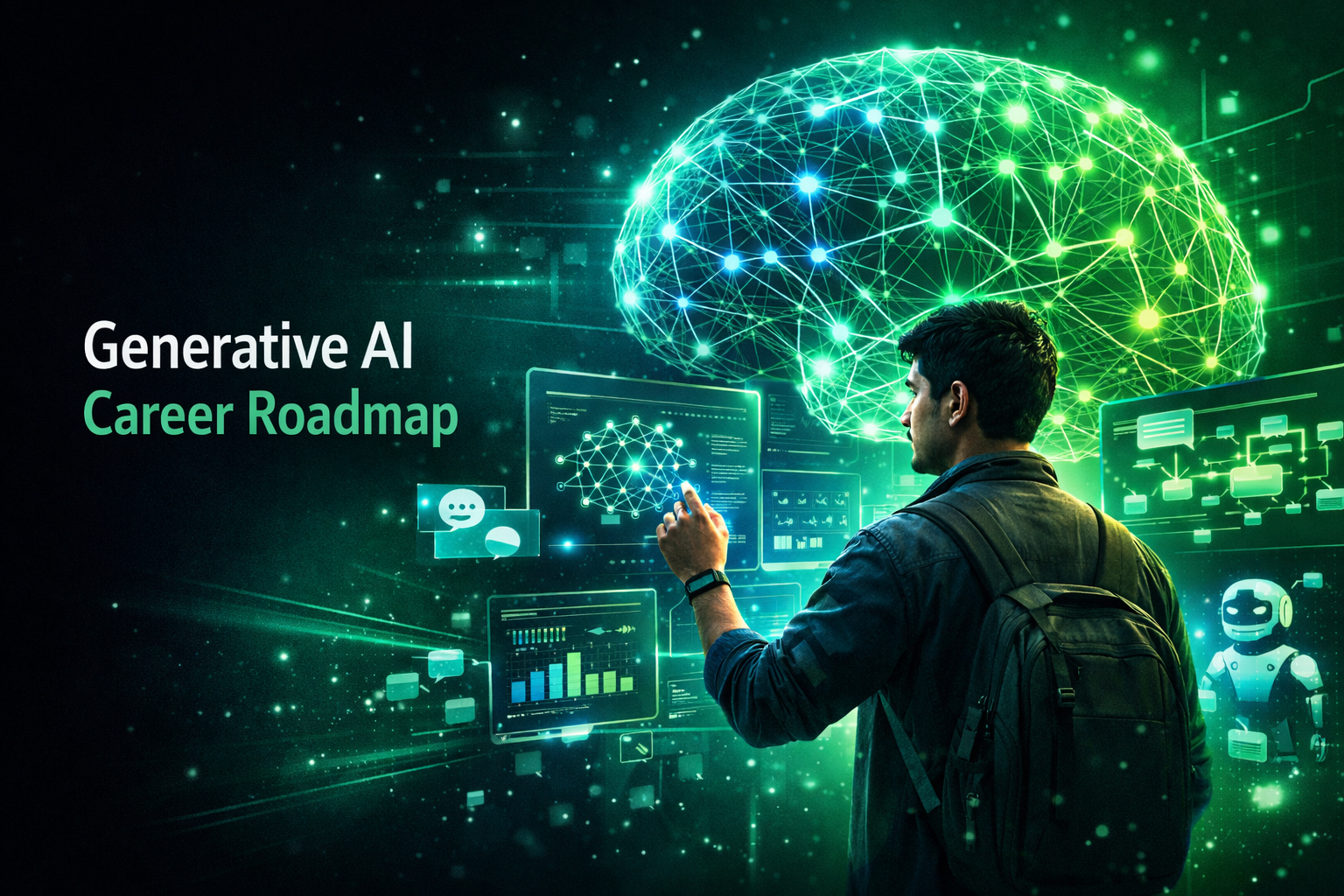
Learn how to start a career in Generative AI with this step-by-step roadmap. Master LLMs, prompt engineering, AI agents, and real-world projects to land high-paying AI jobs in 2026.
Generative AI is no longer just a buzzword—it’s the backbone of modern innovation. From AI-generated art and videos to intelligent chatbots and autonomous systems, the demand for skilled professionals in this field is exploding.
Companies are actively hiring people who understand Large Language Models (LLMs), can build AI Agents, and deploy real-world applications using advanced AI frameworks.
But here’s the problem:
Most beginners feel overwhelmed.
Where do you start?
Do you need coding?
Which tools actually matter?
This guide is your complete, step-by-step roadmap to building a career in Generative AI—whether you’re a student, developer, or someone switching careers.
I’ll break everything down into clear, practical stages, using real-world tools like LangChain Framework, OpenAI API, and Hugging Face Transformers, so you can move from zero to job-ready with confidence.
Step 1: Build Strong Foundations (Don’t Skip This)
Before jumping into fancy tools, you need a solid base. Generative AI is built on mathematics, programming, and machine learning.
Learn Python for AI
Python is the backbone of AI development. You don’t need to master everything—but you must be comfortable with:
-
Data manipulation using Python for AI (NumPy, Pandas)
-
Writing clean scripts
-
Working with APIs
Example:
If you’re building an AI chatbot, you’ll use Pandas to preprocess data and NumPy for handling numerical operations.
Understand Data Preprocessing
Raw data is messy. Before feeding it into models, you must clean and structure it.
Key concepts:
-
Data Preprocessing & Tokenization
-
Removing noise from text
-
Converting text into tokens (input for models)
Real-world example:
When building a chatbot, you convert sentences into tokens so the model understands context.
Learn Deep Learning Basics
You should understand how neural networks work. Focus on:
-
Deep Learning Frameworks (PyTorch, TensorFlow)
-
Loss functions
-
Backpropagation
Why it matters:
These frameworks are used to train and fine-tune AI models.
Step 2: Master Core Generative AI Concepts
Now you move into the real game—understanding how Generative AI actually works.
Large Language Models (LLMs)
LLMs like GPT are trained on massive datasets and can generate human-like text.
Key topics:
-
How LLMs generate responses
-
Prompt-response behavior
-
Limitations like hallucinations
Transformer Architecture
The backbone of modern AI models.
-
Self-attention mechanism
-
Context understanding
-
Parallel processing
Without Transformer Architecture, tools like ChatGPT wouldn’t exist.
Prompt Engineering
This is one of the most in-demand skills today.
You’ll learn:
-
Writing effective prompts
-
Controlling AI outputs
-
Chain-of-thought prompting
Example:
Instead of asking “Explain AI”
Ask “Explain AI in simple terms with real-life examples for beginners”
Embeddings & Semantic Search
This is how AI understands meaning.
-
Convert text into vectors
-
Measure similarity between sentences
Used in:
-
Search engines
-
Recommendation systems
Step 3: Learn Tools & Frameworks (Build Real Skills)
This is where most beginners fail—they learn theory but don’t build.
Let’s fix that.
Hugging Face Transformers
A must-know platform.
-
Access pre-trained models
-
Fine-tune models
-
Experiment quickly
LangChain Framework
Used to build real-world AI applications.
-
Connect LLMs with external data
-
Build workflows
-
Create AI-powered apps
Example: A chatbot that answers questions from PDFs.
OpenAI API / LLM APIs Integration
You don’t need to train models from scratch.
-
Use APIs to build apps
-
Integrate AI into websites
-
Create SaaS products
Vector Databases (Pinecone, FAISS)
Essential for storing embeddings.
-
Fast retrieval of data
-
Used in semantic search
-
Backbone of modern AI apps
Retrieval-Augmented Generation (RAG)
One of the most important concepts.
Instead of relying only on training data, RAG:
-
Retrieves real-time data
-
Improves accuracy
-
Reduces hallucination
Example: Chatbots that answer based on company documents.
Step 4: Advanced Skills (Become Industry-Ready)
Now you go from beginner → professional.
Fine-Tuning (LoRA / PEFT)
Instead of training from scratch:
-
Customize existing models
-
Reduce cost
-
Improve performance
AI Agents / Agentic AI
This is the future.
AI agents:
-
Take decisions
-
Perform tasks
-
Automate workflows
AutoGPT / Autonomous Agents
Self-operating systems that:
-
Plan tasks
-
Execute actions
-
Learn from results
Multimodal AI (Text-Image-Audio Models)
AI is no longer text-only.
-
Combine text + images + audio
-
Build advanced applications
Diffusion Models (Stable Diffusion)
Used for image generation.
-
Create realistic images
-
Used in design, marketing, gaming
Generative Adversarial Networks (GANs)
Two networks competing:
-
Generator vs Discriminator
-
Used for high-quality content creation
Step 5: Build Projects (Most Important Step)
Without projects, you won’t get hired.
Build:
-
AI chatbot using RAG + LangChain
-
Resume analyzer using LLMs
-
Image generator using Diffusion Models
-
AI agent using AutoGPT
Tip: Upload projects on GitHub + LinkedIn.
Step 6: Deployment & MLOps
Building is not enough—you must deploy.
Model Deployment (Docker, FastAPI)
-
Convert models into APIs
-
Deploy on servers
-
Make them accessible
MLOps for Generative AI
-
Monitor models
-
Update models
-
Scale applications
Real-world example:
Companies continuously update chatbots using MLOps pipelines.
Step 7: Career Strategy & Job Roles
Popular roles:
-
Generative AI Engineer
-
Prompt Engineer
-
AI Product Developer
-
Machine Learning Engineer
How to Get Your First Job
-
Build strong portfolio
-
Share content on LinkedIn
-
Contribute to open source
-
Practice interviews
What Most People Miss
To stand out:
✔ Learn problem-solving, not just tools
✔ Focus on real-world applications
✔ Stay updated with AI trends
✔ Build personal brand
Key Generative AI Statistics & Trends You Should Know
-
Around 30% of business leaders believe that the meaningful impact of Generative AI is still years away, despite growing experimentation and early adoption across industries.
-
It is estimated that 30% of total work hours could be directly impacted by AI and automation, highlighting the massive productivity transformation expected across global industries.
-
As of early 2024, the AI startup ecosystem has expanded to nearly 10,000 companies, reflecting rapid innovation and increasing investment in artificial intelligence technologies.
-
Research shows that 56% of employees are already using Generative AI tools at work, with nearly 10% using them daily, indicating fast adoption at the individual level.
-
Only 26% of organizations currently have formal policies for Generative AI usage, while another 23% are still developing guidelines, showing a gap between adoption and governance.
Conclusion: How to Start a Career in Generative AI
Starting a career in Generative AI may feel overwhelming—but it’s actually a step-by-step journey.
If you follow this roadmap:
-
Learn fundamentals
-
Master core concepts
-
Build projects
-
Deploy real applications
-
Showcase your work
You’ll not only understand AI—you’ll be able to build, deploy, and monetize it.
Final Advice:
Don’t wait to feel “ready.”
Start building today.
FAQ: How to Start a Career in Generative AI
1. What is Generative AI?
Generative AI creates content like text, images, and videos using AI models.
2. Do I need coding to learn Generative AI?
Yes, basic Python is essential.
3. How long does it take to learn?
3–6 months for basics, 6–12 months for mastery.
4. What is Prompt Engineering?
It’s the skill of giving effective instructions to AI models.
5. What are LLMs?
Large Language Models that generate human-like text.
6. Is Generative AI a good career?
Yes, it’s one of the highest-demand careers today.
7. What tools should I learn first?
Python, Hugging Face, LangChain.
8. What is RAG?
A method combining retrieval + generation for better accuracy.
9. Do I need math?
Basic understanding is enough.
10. What is fine-tuning?
Customizing AI models for specific tasks.
11. What are AI agents?
Autonomous systems that perform tasks.
12. What is LangChain used for?
Building AI-powered applications.
13. What is a vector database?
Stores embeddings for fast retrieval.
14. Can beginners build AI projects?
Yes, with APIs and tools.
15. What is multimodal AI?
AI that works with text, images, and audio.
16. What is Stable Diffusion?
An AI model for image generation.
17. What is GAN?
A model for generating realistic data.
18. How to get a job in AI?
Build projects + strong portfolio.
19. Is AI replacing jobs?
It’s creating new opportunities.
20. What is MLOps?
Managing and deploying AI models.
21. Can I learn AI without a degree?
Yes, skills matter more than degrees.